Login
Call Us



Want to connect your website or online store with a courier service so you can manage deliveries more efficiently? Fix Web provides professional Courier Service Installation and Integration services to connect supported courier platforms with your website, eCommerce store, or web application.
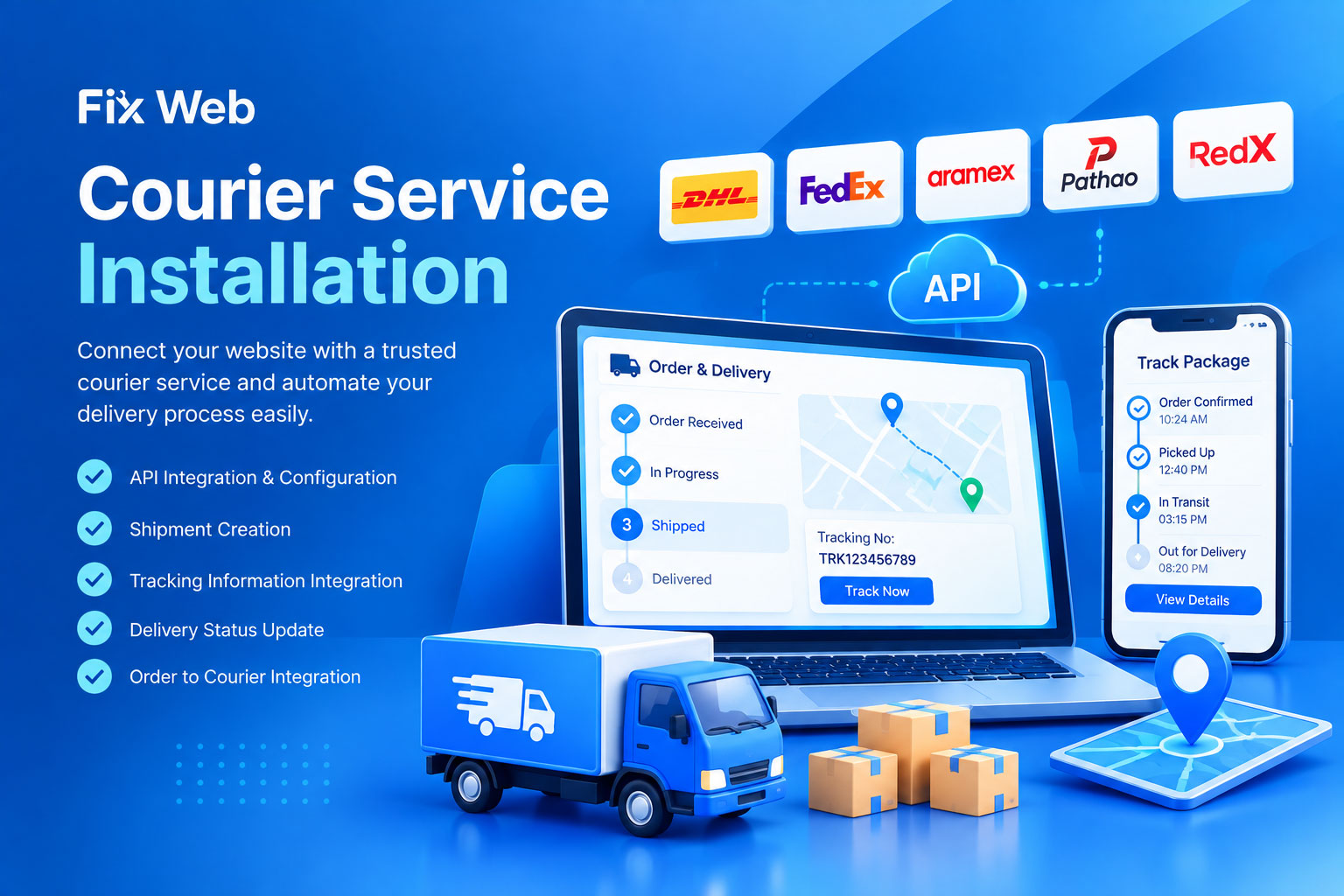
A properly integrated courier service can help automate parts of the order and delivery workflow, such as creating delivery requests, sending customer and order information to the courier, generating tracking information, and updating delivery status where supported by the courier's API.
Our service focuses on the technical installation, configuration, API integration, testing, and troubleshooting required to connect your website with a supported courier service.
Our Courier Service Installation service can include:
Courier API installation
Courier API integration
Courier account configuration
API credential configuration
Order-to-courier integration
Delivery request integration
Parcel information integration
Customer information transfer
Delivery address integration
Cash-on-delivery information integration
Consignment/order ID handling
Tracking number integration
Shipment creation
Delivery status integration
Courier tracking integration
Order status synchronization
Webhook/callback configuration where supported
Sandbox/test-mode configuration where available
Live API configuration
Existing courier integration troubleshooting
Courier API error troubleshooting
The exact features available depend on the courier provider's API, your courier account, and the existing structure of your website or application.
We can integrate supported courier services with compatible platforms such as:
Custom PHP websites
Laravel applications
WordPress websites
WooCommerce stores
Custom eCommerce platforms
Online shops
Order management systems
Service booking platforms
Other API-compatible web applications
If your website uses a different platform, you can provide the website and courier details so we can determine the appropriate integration method.
A typical courier integration can connect your website's order system with the courier provider through its API.
Customer Places Order → Website Receives Order → Courier Request Created → Shipment/Consignment Generated → Tracking Information Returned → Delivery Status Updated
Depending on the courier's available API features, some or all of these steps can be automated.
We first review your website, order system, and selected courier service to understand how the existing system works and what integration options are available.
We review the courier provider's API documentation and determine the required endpoints, credentials, parameters, authentication method, and available features.
The required courier settings are configured according to the provider's integration requirements.
We connect the courier API with the appropriate parts of your website or application. This may include connecting the order system, customer information, delivery address, parcel information, COD amount, and other required data.
Where supported, the integration can allow your website to create shipments and receive relevant tracking or consignment information from the courier system.
If the courier provides status updates through API, webhook, callback, or another supported mechanism, we can configure the website to process those updates appropriately.
We test the integration to verify that the website can communicate correctly with the courier service and that the required order and delivery information is being transferred properly.
After successful testing, the integration can be configured for live operation using the appropriate production credentials and courier account settings.
Depending on the courier API and your website's requirements, the integration may support:
Send relevant order information from your website to the courier system.
Transfer the required customer name, phone number, and delivery information.
Send the customer's delivery location or address information required by the courier.
Transfer COD amounts where supported by the courier's API and your order system.
Create a shipment or delivery request directly from your website where the courier provides this capability.
Receive or store the courier's order, consignment, parcel, or tracking reference.
Connect courier tracking information with the corresponding order on your website where supported.
Receive and process available delivery statuses so your website can reflect the latest shipment information.
Already have a courier integration but it isn't working?
We can investigate issues such as:
Courier API not responding
Authentication errors
Invalid API credentials
Order not being sent to courier
Shipment creation failure
Courier request errors
Incorrect customer information
Incorrect delivery address data
COD amount not transferring correctly
Tracking number not being generated
Tracking information not appearing
Delivery status not updating
Callback/webhook problems
API response handling errors
Sandbox/live configuration problems
Server-side integration errors
The exact cause needs to be investigated because courier integration problems may originate from the website, API credentials, server configuration, courier account, API changes, or the courier provider itself.
Courier integrations may require API keys, authentication tokens, merchant IDs, secret keys, or other account-related configuration information.
We follow a security-conscious approach when handling integration credentials.
Do not send sensitive API credentials through public forms or unsecured messages. If credentials are required, they should be provided through an appropriate secure method.
To install a courier service, we may need:
Website URL
Website/platform information
Name of the courier service
Active courier/merchant account
API documentation, if available
Sandbox credentials, when available
Production API credentials for live deployment
Details of your existing order/checkout system
Any specific courier features you want to use
The exact requirements vary from one courier provider to another.
Courier integrations should be tested before being used for real customer orders.
Depending on the courier's available system, we can verify:
API authentication
Order submission
Customer information transfer
Delivery address transfer
COD information
Shipment creation
Consignment/tracking information
API responses
Error handling
Tracking/status retrieval
Webhook/callback functionality where applicable
Testing availability depends on whether the courier provides a sandbox or test environment.
Courier integration depends on the courier provider's API, your merchant account, available API features, server configuration, and the existing structure of your website.
Fix Web provides the technical installation and integration service. Courier account approval, delivery operations, delivery charges, service areas, COD settlement, courier policies, account restrictions, API availability, and service reliability are controlled by the respective courier provider.
We cannot guarantee features that are not provided by the courier's API.
If additional development is required beyond the agreed courier installation—for example, building a completely new order management system, developing a custom logistics dashboard, or modifying unrelated website functionality—those requirements may need to be assessed separately.
We focus on connecting your website with the courier service according to the available API and technical requirements.
The integration is designed around your existing website order workflow rather than adding an isolated courier feature.
Where supported by the courier API, tracking references and delivery statuses can be connected with your website orders.
If an existing courier integration has stopped working, we can investigate the technical cause and work toward restoring the connection.
We verify the available integration flow before moving it into live operation whenever appropriate testing facilities are available.
Yes, if the courier provides a compatible API or integration method and your website environment supports it.
Yes. Laravel applications can be connected with supported courier APIs.
Yes, when the courier provides a compatible API or integration method. The integration can be designed around the WooCommerce order workflow.
Yes. Custom websites can be integrated with courier APIs when the website has the required technical capabilities.
Potentially, yes. If the courier provides tracking information through its API, the relevant tracking information can be connected with your website's order system.
This depends on the courier's API. If the courier provides suitable status or webhook functionality, automatic status synchronization may be possible.
Yes. We can investigate API errors, authentication problems, failed shipment creation, tracking issues, callback problems, and other technical integration issues.
Generally, yes. The required merchant or business account and API access must be available when the integration requires authenticated courier services.
The required time depends on the courier API, website platform, available features, existing order system, and the complexity of the required integration. A more accurate estimate can be provided after reviewing your requirements.
Make your online order and delivery workflow more efficient with a properly configured courier integration.
Send us your website and courier service details, and let Fix Web handle the technical installation and integration.
The is ipsum dolor sit amet consectetur adipiscing elit. Fusce is eleifend porta arcu In hac habitasse the platea thelorem turpoi dictumst. In lacus libero faucibus malesuada sagittis placerat eros sed istincidunt augue ac ante rutrum sed the is sodales augue consequat.
It is a long established fact that a reader be distracted by the readable content of a page when looking a its layout. Many desktop publishing packages and web page editors now use Lorem Ipsum
It is a long established fact that a reader be distracted by the readable content of a page when looking a its layout. Many desktop publishing packages and web page editors now use Lorem Ipsum
It is a long established fact that a reader be distracted by the readable content of a page when looking a its layout. Many desktop publishing packages and web page editors now use Lorem Ipsum
It is a long established fact that a reader be distracted by the readable content of a page when looking a its layout. Many desktop publishing packages and web page editors now use Lorem Ipsum