Login
Call Us



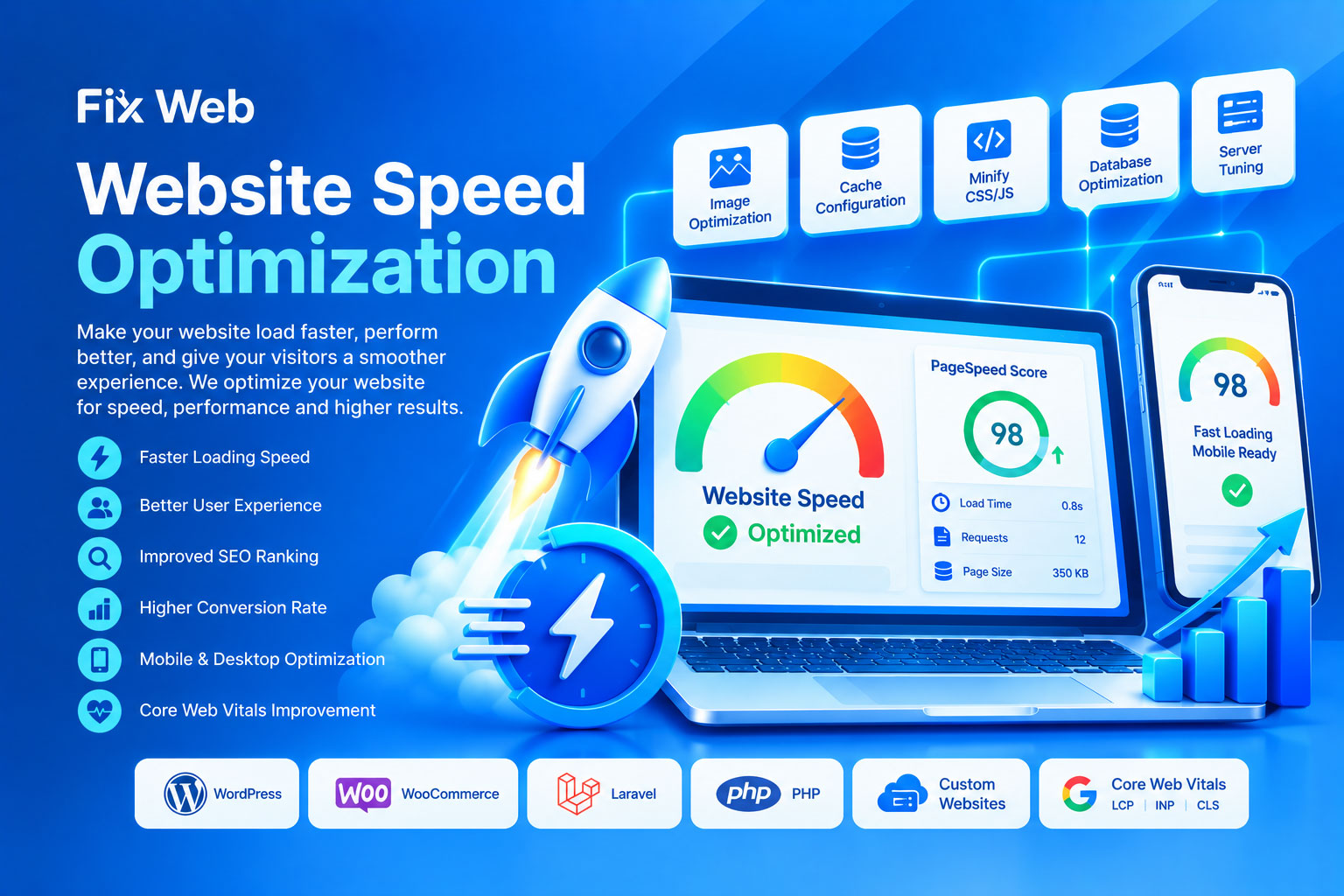
Is your website loading slowly, taking too long to display content, or making visitors wait before they can interact with your pages? Fix Web provides professional Website Speed Optimization services to identify performance problems and improve the loading speed, responsiveness, and overall performance of your website.
Website speed is an important part of the user experience. Slow pages can make visitors leave before the page finishes loading, especially when browsing from mobile devices or slower internet connections. Performance problems can be caused by large images, excessive scripts, inefficient code, database queries, hosting limitations, third-party resources, plugins, themes, or incorrect website configuration.
Our Website Speed Optimization service focuses on finding the major performance bottlenecks and applying appropriate optimizations to improve your website's performance without unnecessarily changing its design or functionality.
Our website speed optimization service can include:
Page loading speed optimization
Website performance analysis
Front-end performance optimization
Image optimization
CSS optimization
JavaScript optimization
HTML optimization
Browser caching configuration
Server-side caching configuration
Cache setup and optimization
GZIP/Brotli compression configuration
Static asset optimization
CSS/JavaScript loading optimization
Render-blocking resource optimization
Unused CSS/JavaScript investigation
Lazy loading implementation
Web font optimization
Database optimization
Database query investigation
PHP performance improvements
WordPress performance optimization
WooCommerce performance optimization
Laravel application optimization
API/request optimization
Third-party resource investigation
Hosting/server configuration review
Mobile performance optimization
Core Web Vitals-related improvements
The exact optimization methods depend on your website's platform, hosting environment, code structure, installed plugins, database, and current performance problems.
There is rarely one single reason for a slow website. Common causes include:
High-resolution images that have not been properly compressed can significantly increase page size and loading time.
Excessive or poorly optimized JavaScript can delay page rendering and user interaction.
Large stylesheets, unused CSS, or render-blocking styles can prevent pages from displaying quickly.
On platforms such as WordPress, unnecessary or poorly optimized plugins can increase server processing time and page size.
Web applications that make inefficient database queries may take longer to generate pages or retrieve information.
Poor hosting resources, server configuration, or overloaded servers can increase the time required for the website to begin responding.
Analytics, advertisements, chat widgets, fonts, tracking scripts, APIs, and other external resources can affect page loading performance.
Without appropriate caching, a website may repeatedly perform the same expensive operations instead of serving optimized cached content.
Before making significant changes, we analyze the website to identify where performance problems are occurring.
Depending on the project, we may examine:
Page loading behavior
Server response time
Page size
Number of requests
Image sizes
CSS files
JavaScript files
Browser console issues
Render-blocking resources
Cache configuration
Database performance
Plugin/theme behavior
API requests
Third-party resources
Mobile performance
Server configuration
This helps us focus on actual performance bottlenecks rather than making random optimization changes.
Images are often one of the largest components of a web page.
Where appropriate, we can optimize:
Image file sizes
Image dimensions
Image compression
Modern image formats
Responsive images
Lazy loading
Image delivery
Unnecessary image loading
The goal is to reduce the amount of data the browser needs to download while maintaining an appropriate visual quality.
We can investigate front-end resources that are unnecessarily slowing down your pages.
Depending on the website structure, optimization may include:
Minifying CSS
Minifying JavaScript
Reducing unnecessary resources
Deferring suitable JavaScript
Delaying non-critical scripts
Optimizing script loading
Reducing render-blocking resources
Removing or reducing unused resources where safely possible
Not every script can be delayed or removed. Some website functionality depends on specific scripts loading in a particular order, so changes should be tested carefully.
Caching can significantly improve the performance of websites that repeatedly generate the same content.
Depending on your website and hosting environment, we can review or configure:
Browser caching
Page caching
Server-side caching
Application caching
Object caching
Static asset caching
Cache expiration settings
The appropriate caching method depends on the website architecture and hosting environment.
For database-driven websites and applications, database performance can have a major impact on page generation time.
Where appropriate, we can investigate:
Slow database queries
Unnecessary queries
Database configuration
Database tables
Index-related issues
Excessive stored data
Application/database interaction
Query performance
Database optimization should be performed carefully, particularly on websites containing important customer, order, transaction, or application data.
For compatible WordPress websites, we can investigate performance issues involving:
Themes
Plugins
Images
WordPress database
Page caching
Browser caching
CSS
JavaScript
Fonts
Third-party scripts
WooCommerce functionality
Server configuration
The objective is to improve performance while keeping the required website functionality working correctly.
Online stores often have additional performance requirements because they may need to process products, variations, carts, customer sessions, checkout functionality, payment systems, and other dynamic information.
We can investigate supported WooCommerce performance issues involving:
Product pages
Shop pages
Category pages
Cart-related performance
Database queries
Plugins
Images
Scripts
Caching
Third-party integrations
Dynamic pages such as cart and checkout pages require special care because aggressive caching can interfere with their functionality.
For compatible Laravel applications, we can investigate performance issues involving:
Database queries
Eloquent queries
Application logic
API requests
Routes
Middleware
Blade templates
Caching
Configuration
PHP performance
Unnecessary processing
Server environment
Where appropriate, Laravel's available caching and optimization mechanisms can be configured according to the application's requirements.
A website that performs well on a powerful desktop computer may still feel slow on a mobile device.
We can review mobile-related performance factors such as:
Large images
Mobile layout resources
JavaScript execution
CSS loading
Font loading
Network requests
Responsive images
Mobile-specific content
The objective is to improve the mobile browsing experience while maintaining the intended website design.
We can also investigate website performance factors associated with commonly used performance metrics such as:
Largest Contentful Paint (LCP)
Interaction to Next Paint (INP)
Cumulative Layout Shift (CLS)
These metrics help identify problems involving loading performance, responsiveness, and visual stability.
Improving these metrics may require changes to images, scripts, CSS, server response time, page structure, fonts, or other website components.
Performance scores can vary depending on testing tools, device, network conditions, server load, location, and other factors. No fixed score or specific performance result can be guaranteed.
We begin by examining the current website performance and identifying the major areas that may be contributing to slow loading.
We analyze the identified bottlenecks and determine whether they are related to images, code, caching, database operations, hosting, third-party resources, or other components.
We select appropriate optimization techniques based on the website's architecture and requirements.
The required changes are implemented carefully, focusing on the identified performance problems.
After optimization, we test important website functionality to make sure performance improvements have not broken forms, navigation, login systems, shopping carts, checkout, payment functionality, or other relevant features.
The website is tested again after optimization to evaluate the effect of the implemented changes.
We review the optimized website and verify that the requested performance-related work has been completed within the agreed scope.
To analyze and optimize your website, it is helpful to provide:
Website URL
Important page URLs
Website/platform information
Hosting information, if known
Known performance problems
Screenshots or performance reports, if available
Information about recent changes, if relevant
If you already have a speed-test report, sharing it can help identify the areas you are most concerned about.
Website speed depends on many factors, including hosting resources, server location, internet connection, website architecture, third-party services, traffic levels, plugins, themes, application code, database performance, and external APIs.
Fix Web can optimize the website components that are within the agreed scope and accessible for modification. We cannot control performance factors completely controlled by third-party hosting providers, external APIs, content-delivery networks, payment providers, or other external services.
Performance-test results may also vary between different tools and testing environments.
Some optimization techniques can affect website functionality if implemented incorrectly. For this reason, optimization should be performed carefully and important website functionality should be tested after major changes.
A current website and database backup is strongly recommended before making significant performance-related changes.
We focus on identifying actual performance bottlenecks rather than applying unnecessary optimization techniques.
Every website is different. We consider the existing platform, code, hosting environment, plugins, database, and functionality before selecting optimization methods.
A website should not simply be fast—it should also continue working correctly. We consider functionality while implementing performance improvements.
We pay attention to performance factors that can particularly affect mobile visitors.
Depending on the project, we can work with compatible WordPress, WooCommerce, Laravel, PHP, and custom web applications.
Yes. We can analyze the website, identify performance bottlenecks, and apply appropriate optimizations. The amount of improvement depends on the existing website and the underlying causes of the slow performance.
Yes. We can investigate WordPress themes, plugins, images, caching, database performance, scripts, and other relevant factors.
Yes. WooCommerce stores can be optimized while taking care to preserve dynamic functionality such as cart, customer sessions, checkout, and payment processing.
Yes. We can investigate compatible Laravel applications for database, application, caching, PHP, API, and front-end performance issues.
Yes. Image compression, resizing, modern formats, responsive images, and lazy loading can be considered where appropriate.
Yes. We can investigate mobile-specific performance issues and optimize suitable page resources and layouts.
We can investigate and optimize factors that may affect LCP, INP, CLS, and other performance-related metrics. However, exact scores cannot be guaranteed because testing results depend on many external factors.
Our goal is generally to improve performance while preserving the existing design and functionality. Some performance improvements may require minor technical or visual adjustments where necessary.
Yes. We can investigate recent changes and determine whether a plugin, theme, code modification, configuration change, or other component is contributing to the slowdown.
The required time depends on the website's size, platform, hosting environment, number of performance problems, and complexity of the required optimization. A more accurate estimate can be provided after reviewing the website.
Don't let slow loading frustrate your visitors or affect their experience.
Send Fix Web your website URL and tell us about the performance problem. We'll analyze the website, identify the major bottlenecks, and work toward making your website faster, smoother, and more responsive.